
Yes, body armor is generally legal for ordinary civilians to own in Illinois. But take that same body armor into Chicago, and you have an entirely different set of rules to worry about.
Under federal law, certain convicted violent felons cannot possess body armor. Under Illinois law, wearing body armor while committing certain offenses can create additional criminal liability. And Chicago? Chicago has an ordinance that generally prohibits civilians from possessing, purchasing, or selling body armor unless they qualify for a specific exemption.
Same protective equipment. Three different layers of law.
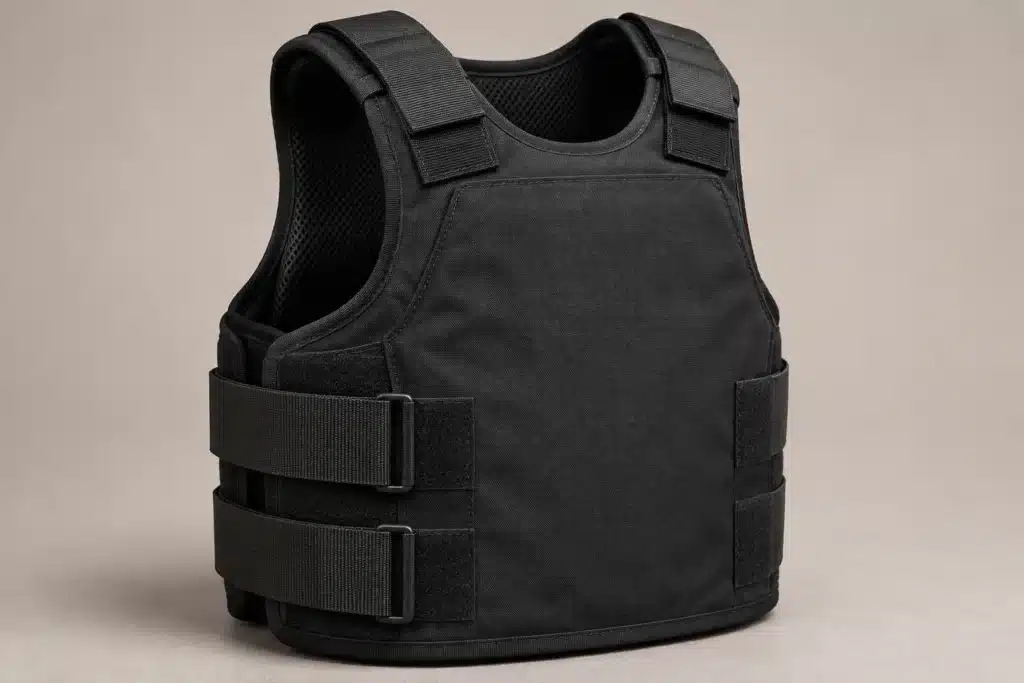
I’ve seen plenty of confusion about this subject. Some people insist that body armor is completely illegal in Illinois. Others believe that because they can legally purchase it, they can wear it wherever they please.
Neither explanation is accurate.
Let’s examine what the laws actually say, who can legally possess body armor, and why driving through Chicago with an armored vest in your trunk raises a question that deserves more than a quick internet answer.
Legal information reviewed November 22, 2026. This article is educational and is not individualized legal advice. Laws and their interpretation can change.
On this page
You can also watch my accompanying explanation here: Is Body Armor Legal in Illinois? — Alpha Koncepts video.
Is Body Armor Legal in Illinois? The Short Answer
If you’re an ordinary civilian without a disqualifying conviction, Illinois generally does not prohibit you from buying, owning, or wearing body armor under a statewide civilian possession ban.
However, that answer comes with qualifications.
| Jurisdiction | General rule | Important limitation |
|---|---|---|
| Federal law | Most civilians are not prohibited from owning body armor | Certain qualifying violent-felony convictions trigger a federal prohibition |
| Illinois state law | No general civilian possession ban identified | Wearing armor during specified criminal conduct, or possessing it in connection with certain weapon offenses, can carry criminal penalties |
| Chicago | Generally prohibits possessing, purchasing, selling, or offering to sell body armor | Specific statutory exemptions apply |
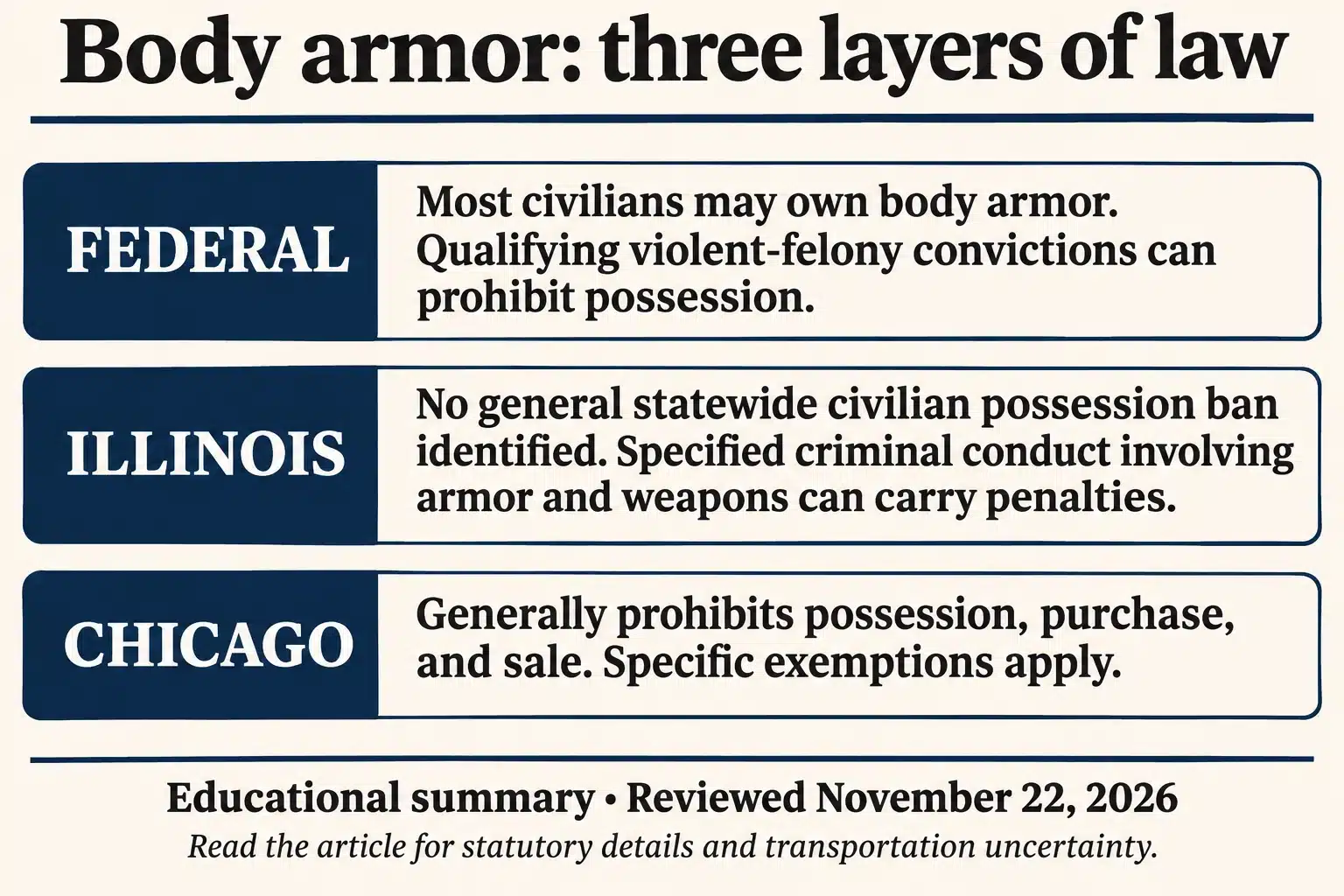
The important distinction is between owning body armor, using it during criminal conduct, and possessing it in a city that has imposed its own restriction.
Those are not interchangeable legal questions.
Federal Body Armor Laws: Who Is Prohibited?
Let’s start with federal law.
Under 18 U.S.C. § 931, a person convicted of a qualifying felony that constitutes a crime of violence is prohibited from purchasing, owning, or possessing body armor.
The statute includes certain federal crimes of violence and qualifying offenses under state law.
Notice what the law does not say.
It does not say that ordinary civilians are prohibited from owning body armor simply because they are not police officers, military personnel, or government employees. The federal restriction is based on the person’s qualifying criminal conviction, not on whether they work in law enforcement.
It is also important not to assume that every felony conviction automatically qualifies under this particular statute. Whether a conviction meets the federal definition requires examining the offense and applicable law.
Federal law defines body armor in 18 U.S.C. § 921(a)(35) as protective body covering intended to protect against gunfire and sold or offered for sale in interstate or foreign commerce.
A knowing violation of § 931 can result in a federal fine, imprisonment for up to three years, or both, under 18 U.S.C. § 924(a)(7).
Does the Federal Law Have an Employment Exception?
There is an important provision in § 931(b), but it is frequently misunderstood.
The law provides an affirmative defense involving prior written certification from an employer that the person’s purchase, use, or possession of body armor was necessary for the safe performance of lawful business activity.
The person’s use and possession must also have been limited to performing that work.
An affirmative defense is not a general body armor license. It does not automatically make someone exempt from state or municipal restrictions. If you have a disqualifying conviction and believe this provision applies to your employment, speak with a qualified attorney before relying on it.
A permission slip you wrote for yourself is not a substitute for understanding federal criminal law.
Illinois Body Armor Laws: What Is Actually Prohibited?
Illinois does have laws specifically addressing body armor.
They appear in Article 33F of the Illinois Criminal Code, titled Unlawful Use of Body Armor.
Article 33F is not a general prohibition on an ordinary, otherwise eligible civilian owning an armored vest. Instead, it addresses particular criminal conduct involving body armor.
What Counts as Body Armor Under Illinois Law?
Section 33F-1 identifies several categories, including:
- Military-style flak or tactical assault vests.
- Soft body armor designed to be concealed beneath clothing.
- Military-style reconnaissance or surveillance vests.
- Certain protective jackets, coats, and other clothing designed to resemble ordinary garments.
So, no, we’re not just discussing tactical plate carriers that look like something worn on a battlefield. Protective clothing that resembles an ordinary jacket may also fall within the statute, depending on its design and characteristics.
When Does Wearing Body Armor Become a Crime?
720 ILCS 5/33F-2 addresses a person who knowingly wears body armor while possessing a dangerous weapon other than a firearm during the commission or attempted commission of an offense.
The statute’s reference to a dangerous weapon uses the categories defined in Illinois law.
Section 33F-3 establishes the sentencing classification for that particular body-armor offense:
- First conviction: Class A misdemeanor.
- Second or subsequent conviction: Class 4 felony.
These provisions have specific elements. Simply wearing a ballistic vest while shopping, walking outside, or attending a training class does not, by itself, satisfy § 33F-2.
However, that does not mean body armor is legally irrelevant when firearms are involved. Other Illinois weapon statutes can carry much more serious consequences.
Can Body Armor Turn a Weapon Offense Into a Class X Felony?
Yes, under certain circumstances.
This is where the distinction between the statutes becomes extremely important.
Under 720 ILCS 5/24-1.1, a violation of the state’s prohibition on weapon possession by certain convicted felons while wearing or possessing body armor is classified as a Class X felony carrying a specified prison term of 10 to 40 years.
Another provision, 720 ILCS 5/24-1.6, addresses aggravated unlawful possession of a weapon. One sentencing provision treats specified conduct involving body armor and the absence of a valid Firearm Owner’s Identification Card as a Class X felony.
These are serious offenses with additional statutory requirements.
Simply owning body armor is not what triggers the 10-to-40-year sentence. The underlying weapon offense and the applicable enhancement must be established.
That is why broad statements such as “body armor is a felony in Illinois” are misleading. The details matter. In criminal law, they matter quite a bit.
Chicago’s Body Armor Ban: A Very Different Law
Now we get to Chicago.
Of course, Chicago.
Unlike the general Illinois statewide rules, Chicago has an ordinance that expressly prohibits the sale, purchase, and possession of body armor, subject to stated exemptions. The relevant law is Municipal Code of Chicago § 8-4-148.
The ordinance was adopted on March 28, 2018, and amended on April 18, 2018. The provision remains in the city’s published 2026 municipal code.
Subsection (b) prohibits four activities:
- Selling body armor.
- Offering body armor for sale.
- Possessing body armor.
- Purchasing body armor.
That third item is the one I want you to notice.
Possession.
The ordinance is not limited to wearing body armor during a crime. It does not require you to be carrying a firearm. And it contains no general exemption for ordinary civilians who purchased armor legally for personal protection.
I disagree with laws that prevent otherwise law-abiding people from owning protective equipment. But whether I like the ordinance has nothing to do with whether it is on the books.
If you’re in Chicago, you need to understand that distinction.
What Does Chicago Consider Body Armor?
The city’s definition includes several categories similar to those in the Illinois statute, including tactical vests, concealable soft armor, reconnaissance vests, and certain protective clothing.
There is an important exclusion, however.
The Chicago ordinance expressly excludes non-ballistic protective clothing and certain Kevlar-lined protective gear manufactured, advertised, and sold as motorcycle protective clothing.
This does not create a blanket exemption for every garment containing Kevlar. The purpose and characteristics of the equipment matter.
What Are the Penalties for Violating Chicago’s Ordinance?
Under § 8-4-148(d), a violation is subject to a fine ranging from $500 to $1,000.
For businesses holding city licenses, the ordinance also allows suspension or revocation of applicable licenses. Each item sold may constitute a separate violation.
These are the penalties specified by Chicago’s municipal ordinance. They should not be confused with the much more serious state and federal criminal penalties discussed earlier.
Who Is Exempt From Chicago’s Body Armor Ban?
Chicago’s ordinance identifies six categories of exemptions.
This section is particularly important because the exemptions are more specific than many people realize.
1. Active or Retired Peace Officers
The ordinance exempts active or retired peace officers.
Whether an individual’s position qualifies for this category depends on the applicable legal meaning of peace officer and their status.
2. Retired Police Officers
Yes, the ordinance separately identifies retired police officers.
That may seem redundant after the previous category, but these are two distinct entries in the municipal code.
3. Military Members, Emergency Responders, and Licensed Security Officers
This category covers members of the United States Armed Forces, emergency responders, and licensed security officers.
Pay attention to those descriptions.
The ordinance does not say that every person who previously served in the military automatically qualifies. A veteran should not assume that past service alone establishes the exemption.
Chicago also specifically defines emergency responder to include certain police officers, firefighters, paramedics, and emergency medical technicians employed by the city or performing official duties within Chicago.
And what about security officers?
The ordinance uses the term licensed security officers.
Illinois has its own system of private-security registration, licensing, and firearms credentials. Your exact status needs to be verified rather than assumed. If you would like to become a licensed security officer, check www.academysecuritytraining.com
If your job depends on wearing body armor in Chicago, confirm your eligibility and relevant credentials before relying on the exemption.
4. Government Employees Performing Official Duties
Certain employees of Chicago, Illinois, the federal government, or other local government units are exempt when on duty and acting in their official capacities.
Government employment by itself should not be treated as permission to possess armor for any personal purpose.
The ordinance expressly includes work-related limitations for this category.
5. News Media Employees Performing Official Duties
News media employees also have an exemption when on duty and acting in their official capacities.
For example, the ordinance recognizes that journalists may need protective equipment while performing certain assignments.
But again, the relevant employment and duty requirements matter.
6. Authorized Entertainment Production Props
The final category concerns people authorized and permitted to acquire body armor solely for use as props in motion pictures, television, or video entertainment production.
This is a specific production-related exemption, not general permission for anyone to purchase armor and call it a costume.
What About Ordinary Civilians?
Here’s what’s missing from that list:
An ordinary civilian who simply wants body armor for personal protection.
Chicago does not provide a broad self-defense exemption in § 8-4-148.
And remember, qualifying for a Chicago exemption does not override federal restrictions that may separately apply to you.
Can You Drive Through Chicago With Body Armor in Your Trunk?
This may be the most interesting practical question of the entire discussion.
Imagine you live outside Chicago, legally own an armored vest, and need to drive across the city.
You put the vest in your trunk. You’re not wearing it. You’re not stopping to sell it. You’re simply passing through.
Is that legal?
The published ordinance does not provide an express exemption for simply transporting body armor through Chicago.
It prohibits possession, and it does not separately explain how that restriction applies to every situation involving a person traveling through the city with armor in a vehicle.
So I cannot tell you that keeping armor in your trunk automatically makes the trip lawful. I also would not claim that every possible trip necessarily results in a violation without considering the relevant legal facts and potential defenses.
If you regularly travel through Chicago with body armor, get guidance from a qualified Illinois attorney. The last place you want to resolve a complicated interpretation of municipal law is during an encounter with law enforcement.
What About the Rest of Cook County?
Chicago’s ordinance applies within Chicago. That does not automatically make it the rule in every Cook County suburb. Oak Park, Evanston, Melrose Park, and other municipalities have their own local governments and municipal codes.
But in researching this topic, I did not identify a comparable civilian possession ban in those particular communities. That should not be mistaken for an approval that their laws contain no body armor restrictions. Local ordinances can change, and I didn’t check every single municipality.
It would also be a mistake to assume that a rule about firearm preemption automatically invalidates local body-armor restrictions. Firearms and protective clothing are different legal subjects.
If you want to understand the broader legal concept of Illinois firearm preemption, see our article on Illinois preemption for gun owners. But do not treat firearm preemption rules as a substitute for checking the law that actually applies to body armor.
For municipal research, start with the jurisdiction’s official website and current code, including resources such as the American Legal Publishing Code Library where applicable. Municode is another good resource.
Did Illinois Pass a Statewide Body Armor Ban?
No statewide civilian possession ban resulted from Illinois House Bill 3238. HB 3238, introduced during the 103rd General Assembly in 2023, proposed broader restrictions involving armor plates, body armor, and military helmets.
The proposal included possession restrictions and other rules with exceptions. But here’s the critical fact: The bill did not become law. Its legislative history shows that the session ended on January 7, 2025, without the proposal being enacted.
That’s why it’s important to distinguish a bill that somebody introduces from a law that actually passes. Seeing a proposed restriction online does not mean the restriction is currently enforceable. At the same time, the failure of one proposal does not mean Illinois lawmakers cannot introduce another in the future.
Always check the current statutes and legislative history, especially when reading older articles about proposed gun or body-armor legislation.
Frequently Asked Questions About Body Armor in Illinois
Can an ordinary civilian own a bulletproof vest in Illinois?
Generally, yes, under statewide law. However, federal restrictions based on qualifying violent-felony convictions and applicable local ordinances can change the answer.
Do you need a FOID card to buy body armor?
The Illinois body-armor provisions discussed here do not establish a general statewide FOID-card requirement solely for ordinary civilian ownership of body armor.
A FOID card is associated with Illinois firearm and ammunition law. Do not confuse that with a blanket requirement for protective equipment.
However, lack of a valid FOID card can be significant when analyzing certain underlying firearm offenses involving body armor.
Is there a minimum age for owning body armor?
The federal body-armor prohibition and Illinois Article 33F provisions discussed above do not establish a general minimum ownership age for otherwise eligible people.
That does not mean every purchase involving a minor is automatically permitted in every circumstance. Retailer policies and other applicable rules may matter.
Is it legal to wear body armor in public in Illinois?
Under the statewide provisions discussed, wearing armor by itself generally is not prohibited for an otherwise eligible person.
But local restrictions apply, and wearing body armor during specified criminal conduct may carry serious consequences.
Chicago is the major exception addressed in this article.
Can a licensed security officer wear body armor in Chicago?
Chicago expressly lists licensed security officers among its exempt categories.
Whether a particular individual qualifies requires evaluating their actual credentials and circumstances. Do not assume every security employee, trainee, or cardholder automatically meets the legal definition.
Can I buy body armor outside Chicago and bring it into the city?
A lawful purchase outside Chicago does not automatically exempt you from Chicago’s possession restriction.
The city’s ordinance regulates possession independently of where the armor was purchased.
Are body armor plates treated differently from soft armor?
Federal, Illinois, and Chicago provisions use definitions broad enough to encompass different types of ballistic protection. Whether a specific item qualifies depends on the applicable legal definition and the product’s characteristics.
A plate carrier without ballistic inserts, for example, should not automatically be assumed to have the same legal classification as a complete ballistic armor system.
Can someone with a felony conviction possess body armor?
It depends on the conviction and applicable laws.
Federal § 931 prohibits possession by people convicted of specified violent felonies. It does not use every felony conviction as an automatic trigger.
Anyone with a potentially disqualifying criminal history should obtain individualized legal advice before purchasing or possessing armor.
The Bottom Line on Body Armor in Illinois
Body armor is not generally banned for ordinary civilians throughout Illinois. But that doesn’t mean every person can legally own it, and it certainly doesn’t mean every Illinois municipality treats possession the same way.
Federal law restricts certain people with qualifying violent-felony convictions.
Illinois law imposes criminal penalties for specific conduct involving body armor and weapons.
Chicago has a much broader municipal restriction on possession and sales, with expressly listed exemptions.
Personally, I believe ordinary, law-abiding people should be able to own protective equipment without unnecessary government restrictions. But knowing what the law should be and understanding what it currently says are two different things.
Whether you’re considering buying body armor for personal protection, using it for employment, or traveling through Chicago, do your homework before making assumptions.
If you’re also interested in improving your broader personal-defense skills, explore the training classes offered by Alpha Koncepts.
And if you’ve identified another Illinois municipality with a body-armor possession restriction, share the city and ordinance number in the comments. Specific legal citations are far more useful than rumors.
Be armed. Be trained. Be Alpha.
Disclaimer: This article provides general educational information, not legal advice. Municipal codes and state and federal laws may be amended, and their application depends on specific facts. Consult an Illinois attorney for advice about your circumstances.
Get notified about classes, changes to the law, and more! Sign up today.